Dashen Super App
Ethiopia's most comprehensive digital banking super app, consolidating payments, chat banking, e-commerce, budgeting analytics, and lottery into a single platform for Dashen Bank's customer base. The system serves tens of thousands of active users under strict financial-grade reliability requirements.
Client
Dashen Bank · Eagle Lion System Technology
My Role
Backend Developer
Timeline
Feb 2025 – Present
Status
Live · Active Development
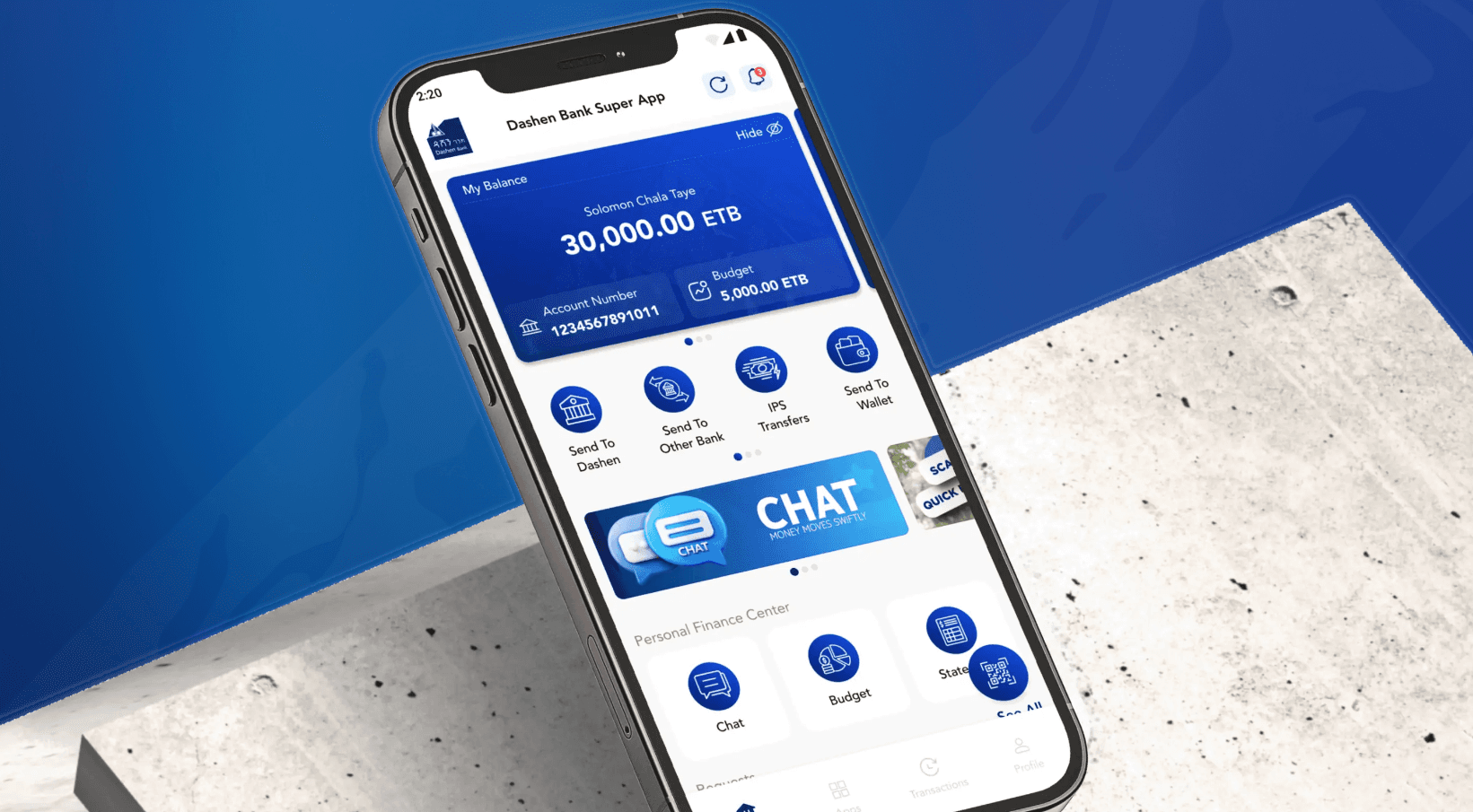
Dashen Bank needed a unified digital platform to compete with global super apps while satisfying the compliance and reliability requirements of regulated banking. The challenge: integrate five separate product domains — payments, e-commerce, chat banking, budgeting, lottery — with a shared identity layer, without compromising the transaction integrity a bank demands.
Domain-bounded microservices communicating through a dual-broker event layer. gRPC for synchronous, latency-sensitive operations. Kafka for the high-throughput financial event stream. RabbitMQ for reliable task queuing requiring guaranteed exactly-once delivery semantics.
Routes mobile and web traffic, enforces authentication, rate limiting, and request validation before passing to upstream services.
Payment, E-commerce, Chat Banking, Lottery, and Budgeting — each deployed as an independent Go service with its own data store.
Kafka handles the financial event backbone. RabbitMQ manages task queues with dead-letter queue support for failed message recovery.
Service-owned databases enforce domain isolation. Redis caches hot-path reads and manages distributed session state.
Containerized workloads on Kubernetes with rolling deployments, readiness probes, and auto-scaling for traffic spikes.
- 1
Designed the backend service topology — defining service boundaries, ownership contracts, and inter-service communication patterns across five product domains.
- 2
Built the event-driven core using Kafka topics and RabbitMQ queues, ensuring no financial event is lost even under service failure through idempotent consumer design.
- 3
Led the internal API design: gRPC service contracts for the service mesh, REST endpoints for mobile client integration.
- 4
Implemented the payment orchestration service handling fund transfers, wallet top-ups, merchant payments, and transaction status tracking.
- 5
Defined Kubernetes deployment manifests, resource limits, health check probes, and rolling update strategies for zero-downtime production rollouts.
Financial Transaction Consistency Across Services
Multi-step financial operations must be atomic or fully compensated. Implemented the saga pattern: each step publishes an event to Kafka, and rollback consumers handle partial failures — eliminating distributed transaction locks while preserving end-to-end correctness.
Per-User Event Ordering at High Throughput
Lottery events, payment confirmations, and e-commerce updates needed strict per-user ordering without global sequencing bottlenecks. Solved by partitioning Kafka topics by user ID, giving per-user ordering with horizontal throughput scaling.
Zero-Downtime Deployments for Financial Services
Active payment flows cannot tolerate cold-start downtime. Configured Kubernetes readiness probes checking gRPC health endpoints before routing live traffic, combined with rolling deployment strategies keeping old pods alive until new ones fully pass health checks.
Platform serving tens of thousands of active registered users across Ethiopia
Five product domains — payments, e-commerce, lottery, chat banking, budgeting — unified under a single identity layer
Zero-downtime deployments achieved across all services on Kubernetes
Financial events processed with at-least-once delivery guarantees via Kafka consumer groups with idempotent handlers
“The hardest part of a super app backend isn't any individual service — it's maintaining their independence. Every shortcut crossing service boundaries becomes debt that limits your ability to scale domains independently. Strict ownership contracts and event-driven integration are not optional in financial systems; they are the architecture.”